
I at India International Centre, Delhi

DARK CHOCOLATE
DEMOCRACY
Dark Chocolate Democracy is an artist's reflection on the fragile relationship between the individual and the collective within a democratic society. Developed as a handmade pop-up art book, the project explores how personal memories, private experiences and public conversations constantly intersect to shape our understanding of democracy. Rather than presenting political arguments directly, Sankha Banerjee constructs an immersive visual narrative where fragmented images, layered paper structures and non-linear storytelling invite viewers to reconsider the everyday realities of participation, freedom and coexistence.
The title itself offers a metaphor. Like dark chocolate, democracy possesses complexity—simultaneously bitter and sweet, hopeful and uncomfortable. It demands participation while exposing contradiction; it promises freedom while continually negotiating differences. Banerjee embraces this ambiguity, suggesting that democracy cannot be understood through fixed definitions but through lived experiences and ordinary encounters. The work becomes less a political statement than an invitation to reflect upon the spaces where individuals meet, disagree, remember and imagine together.
Central to the exhibition is the dialogue between the private and the public sphere. The project considers democracy as a condition sustained through communication, mutual recognition and the acceptance of diversity. Private experiences acquire meaning when they enter public discourse, while public spaces remain meaningful only when they acknowledge individual autonomy. These interconnected ideas form the conceptual foundation of the exhibition, transforming abstract political theory into a deeply personal visual experience.
Banerjee assembles drawings, handwritten elements, printed transparencies, layered papers and sculptural pop-up mechanisms into an artist's book that unfolds as viewers interact with it. Each page reveals new visual relationships rather than a linear sequence of events. Images overlap, disappear and re-emerge, echoing the fragmented nature of memory and public discourse. The handmade quality of the work reinforces the sense of intimacy, reminding audiences that democracy is not simply an institutional structure but something continuously constructed through human relationships and everyday acts of expression.
Pop-up Art Book Exhibition


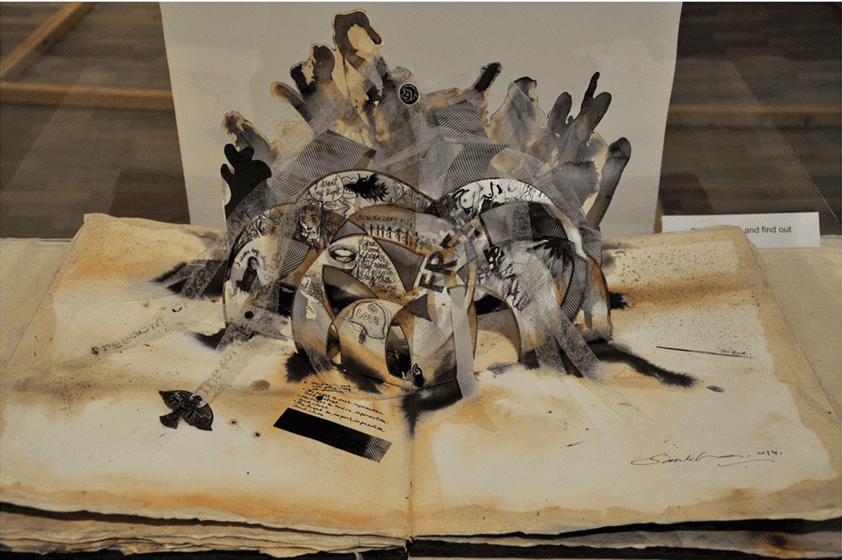
The exhibition deliberately avoids offering definitive conclusions. Instead, it creates a space for questioning. How do personal memories become part of collective history? How do private anxieties influence public action? Can dialogue survive within increasingly divided societies? These questions are embedded within the physical architecture of the book itself, where every fold, cut and unfolding surface reveals another layer of meaning.
Created using ink, watercolour, acid-free paper, Nepali handmade paper and translucent tracing sheets, the artwork reflects Banerjee's long-standing interest in expanding the possibilities of the artist's book as both a narrative and sculptural medium. The handcrafted object becomes a democratic space in miniature—one that requires participation, curiosity and contemplation from its audience.
Dark Chocolate Democracy demonstrates how visual storytelling can transform political ideas into intimate experiences. By weaving together fragments of observation, memory and material experimentation, the exhibition reminds viewers that democracy is ultimately sustained not only by constitutions and institutions but by the everyday conversations, differences and shared spaces through which people continually negotiate what it means to live together.
SANKHA BANERJEE
