

War is often explained through history, politics or economics, yet every generation finds itself repeating the same cycles of destruction. WHY WAR begins with a more unsettling question: if humanity has learned so much about peace, why does it continue to return to violence? Conceived through the script of Sibaji Bandyopadhyay and realised through the visual narration of Sankha Banerjee, the graphic narrative investigates war not as an isolated historical event but as a recurring condition of human existence.
Inspired by the celebrated letter exchange between Albert Einstein and Sigmund Freud, the work explores the possibility that violence cannot be understood solely through diplomacy, ideology or military history. Freud's proposition that civilization coexists with an instinct towards destruction becomes the point of departure. Rather than portraying war as an accident of politics, the narrative examines aggression as an impulse embedded within the human psyche—one that repeatedly resurfaces despite the promises of progress and reason.
The graphic novel unfolds across multiple temporal and psychological landscapes, where ancient battlefields merge with contemporary conflicts. Soldiers, civilians, children and anonymous witnesses appear not as historical characters but as recurring human figures caught within an endless cycle of fear, obedience and destruction. War becomes less a clash between opposing nations than a mirror reflecting humanity's unresolved relationship with power, identity and mortality.
While Freud provides the psychological foundation, the work extends into contemporary philosophy through the writings of Jacques Lacan and Michel Foucault. Lacan's understanding of desire reveals how identities are constructed through conflict and opposition, while Foucault's analysis of power demonstrates that violence is not confined to bombs and battlefields. Modern societies produce subtler forms of violence through surveillance, institutions, language and systems of control. The work therefore asks whether the twenty-first century has truly become more peaceful, or whether violence has merely become less visible
KENO YUDDHA(WHY WAR)
SCRIPT I SIBAJI BANDYOPADHYAY
ART I SANKHA BANERJEE
SARADIA EI SAMOY, 2016
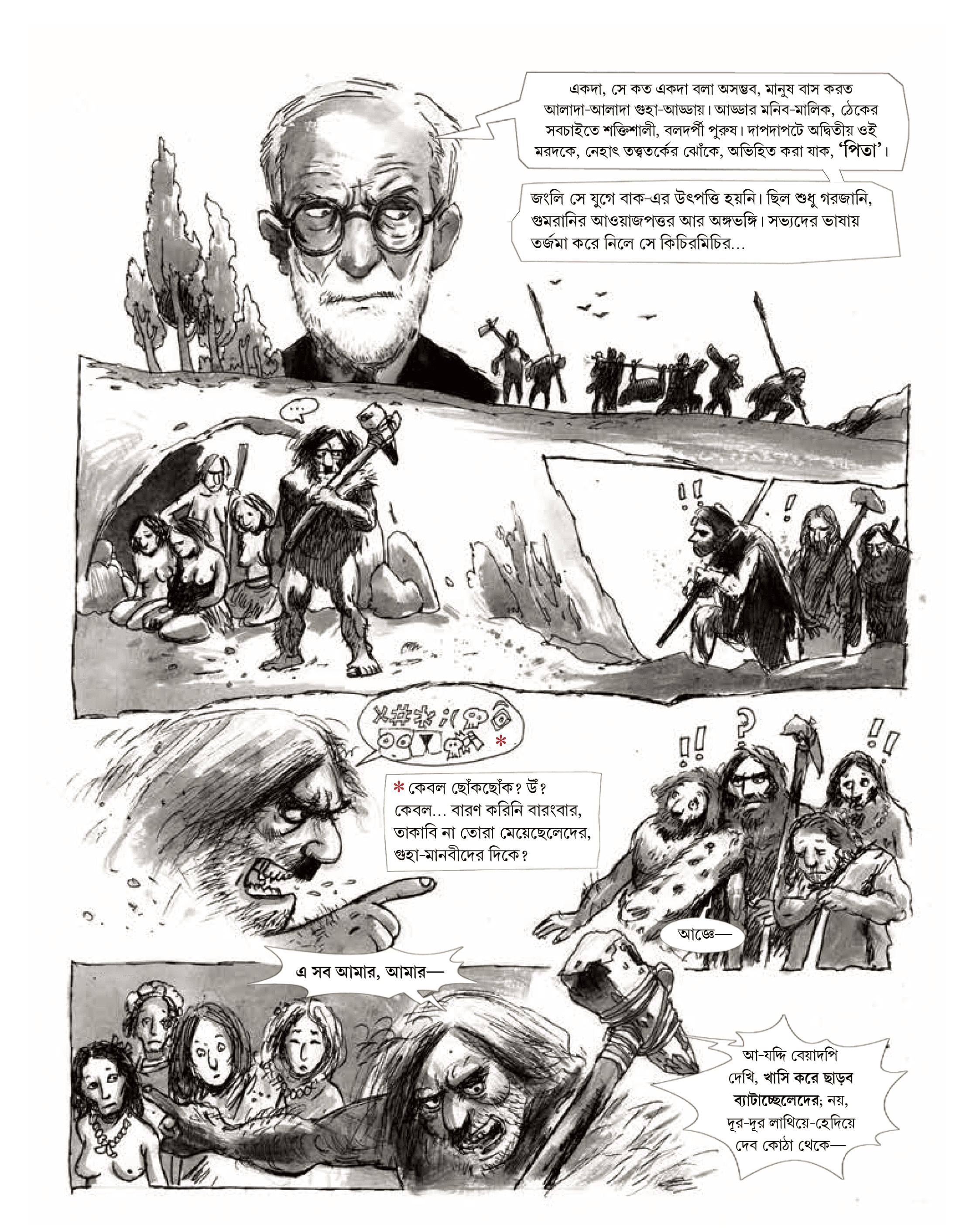


Rather than illustrating philosophical theories, Sankha Banerjee develops a visual language that embodies them. Fragmented compositions, stark black-and-white contrasts and shifting narrative rhythms evoke the instability of memory and the uncertainty of contemporary existence. The comic moves fluidly between realism and symbolism, allowing psychological tension to emerge through silence, repetition and visual metaphor. Individual scenes resist definitive interpretation, encouraging readers to participate in constructing meaning rather than consuming a predetermined narrative.
Situated within the uncertainties of postmodern thought, WHY WAR rejects simple moral binaries of hero and enemy, victory and defeat. Instead, it presents violence as a complex network of psychological drives, political structures and cultural memories that continue to shape the present. The work suggests that every war leaves traces far beyond the battlefield—in language, collective memory, inherited trauma and everyday life.
Rather than seeking answers, WHY WAR invites reflection. It asks readers to confront one of the oldest questions of civilization through the language of graphic storytelling, where philosophy, psychoanalysis and visual art converge. The result is not a history of war, but an exploration of the human mind that continues to imagine, justify and repeat it.


SANKHA BANERJEE
