


For more than 15 years, artist Sankha Banerjee has been engaged in one of the most ambitious visual reinterpretations of the Mahabharata in contemporary Indian art. Rather than illustrating the epic through familiar mythological conventions, Banerjee approaches the text as a living cultural archive whose visual identity has continuously evolved across history. His graphic novels Vyasa: The Beginning (2017) and Panchali: The Game of Dice (2022), created in collaboration with scholar Sibaji Bandyopadhyay, represent one of the first extensive sequential-art adaptations based on the Critical Edition of the Mahabharata prepared by the Bhandarkar Oriental Research Institute.
At the heart of Banerjee's practice lies a fundamental question: How should the Mahabharata look today? The answer, for him, cannot be found in simply reproducing inherited visual stereotypes. Instead, his work investigates the epic through archaeology, history, sociology, anthropology, theatre, and material culture to construct an entirely new visual language.
Unlike many popular representations influenced by television serials or calendar art, Banerjee rejects the notion that there exists a single "authentic" appearance of the Mahabharata. His research demonstrates that every historical period has imagined the epic differently. Temple sculptures at Mahabalipuram, Ellora, and Halebidu, Mughal paintings of the Razmnama, Rajput miniatures, Bengal and Odisha patachitra traditions, Raja Ravi Varma's paintings, Amar Chitra Katha comics, B.R. Chopra's television adaptation, and Peter Brook's theatrical production all reveal that the epic has constantly acquired new visual forms according to changing historical and cultural contexts.
This historical understanding becomes the foundation of Banerjee's artistic philosophy. Rather than attempting to reconstruct a fictional "ancient" India, he embraces the fact that the Mahabharata itself accumulated multiple historical layers during centuries of oral transmission and textual composition. Since no contemporary visual record survives from the period in which the epic was composed, every artist inevitably recreates the epic through the visual vocabulary of their own time. Banerjee therefore argues that artists are not obligated to imitate previous representations but are free to develop new visual identities grounded in rigorous research. His reconstruction begins with extensive archaeological and historical investigation.
Costumes, ornaments, architecture, weapons, domestic objects, landscapes, and social spaces are studied from archaeological evidence rather than from popular mythology. Instead of presenting polished fantasy kingdoms, Banerjee imagines a material world that feels textured, inhabited, and historically plausible. Clothing varies according to social hierarchy, profession, and personality; settlements emerge from historical imagination rather than decorative spectacle; forests, villages, and roads become active narrative spaces instead of ornamental backgrounds.
On a huge battlefield stand two armies facing each other. The dust stirred by soldiers covers the sun. Rain-clouds shower flesh and blood, drenching the troops. Along the ground a wind rises; the small stones that the wind carries with it, hit the warriors.With cinematic effects, full of cuts and intercuts, Vyasa-with 1600 electrifying visuals for hot-hearted adults-sets in motion the battlefield of Kurukshetra. From the birth of the Pandavas and Kauravas to the interpenetration of life instincts and death instincts, this first book in this graphic book series rolls out the beginning of interplay of lust and violence which gives to the tale of war, revenge and peace the unmatched regal look.
VYASA I THE BEGINING
Words: Sibaji Bandyopadhyay
PENGUIN INDIA, 2017
GET YOUR BOOK https://amzn.in/d/00fDrCeg


SKETCHBOOK
Now, the game really gets going.
And it doesn't let go. ... A disputed inheritance fuels a hydro-carbon fire-storm and five forest dwellers and their mother burn to ashes in the wax-house of regal deceit. ... Then, the throw of dice changes everything ....
Sibaji Bandyopadhyay's distilled narrative introduces new witnesses to an old story. Sankha Banerjee's incandescent composition produces a counter-epic. This magnificent, rich and complex new turn in the telling transforms the colour and texture of the Mahabharata.
- Raqs Media Collective, curator


Equally important is Banerjee's sociological approach. His Mahabharata does not revolve exclusively around kings and heroes. Throughout both graphic novels, ordinary labourers, cooks, travellers, hunters, farmers, honey collectors, woodcutters, artisans, and anonymous workers occupy the visual field alongside celebrated protagonists. These figures often remain unnamed, yet they embody the social world that sustains the epic's civilisation. By foregrounding everyday lives, Banerjee transforms the Mahabharata from a story about royal dynasties into a broader narrative about society itself.
His interpretation is equally informed by performance traditions across India. The narrator Sauti is visualised not as a distant sage but as an itinerant storyteller whose appearance draws inspiration from Kathakali, Theyyam, folk performers, and Chadar-Badar puppetry. Colour, costume, gesture, theatrical makeup, and performance become essential narrative devices. This emphasis acknowledges the oral traditions through which the Mahabharata travelled for centuries before becoming a written text, allowing the graphic novel to recover something of the epic's performative origins.
His interpretation is equally informed by performance traditions across India. The narrator Sauti is visualised not as a distant sage but as an itinerant storyteller whose appearance draws inspiration from Kathakali, Theyyam, folk performers, and Chadar-Badar puppetry. Colour, costume, gesture, theatrical makeup, and performance become essential narrative devices. This emphasis acknowledges the oral traditions through which the Mahabharata travelled for centuries before becoming a written text, allowing the graphic novel to recover something of the epic's performative origins.


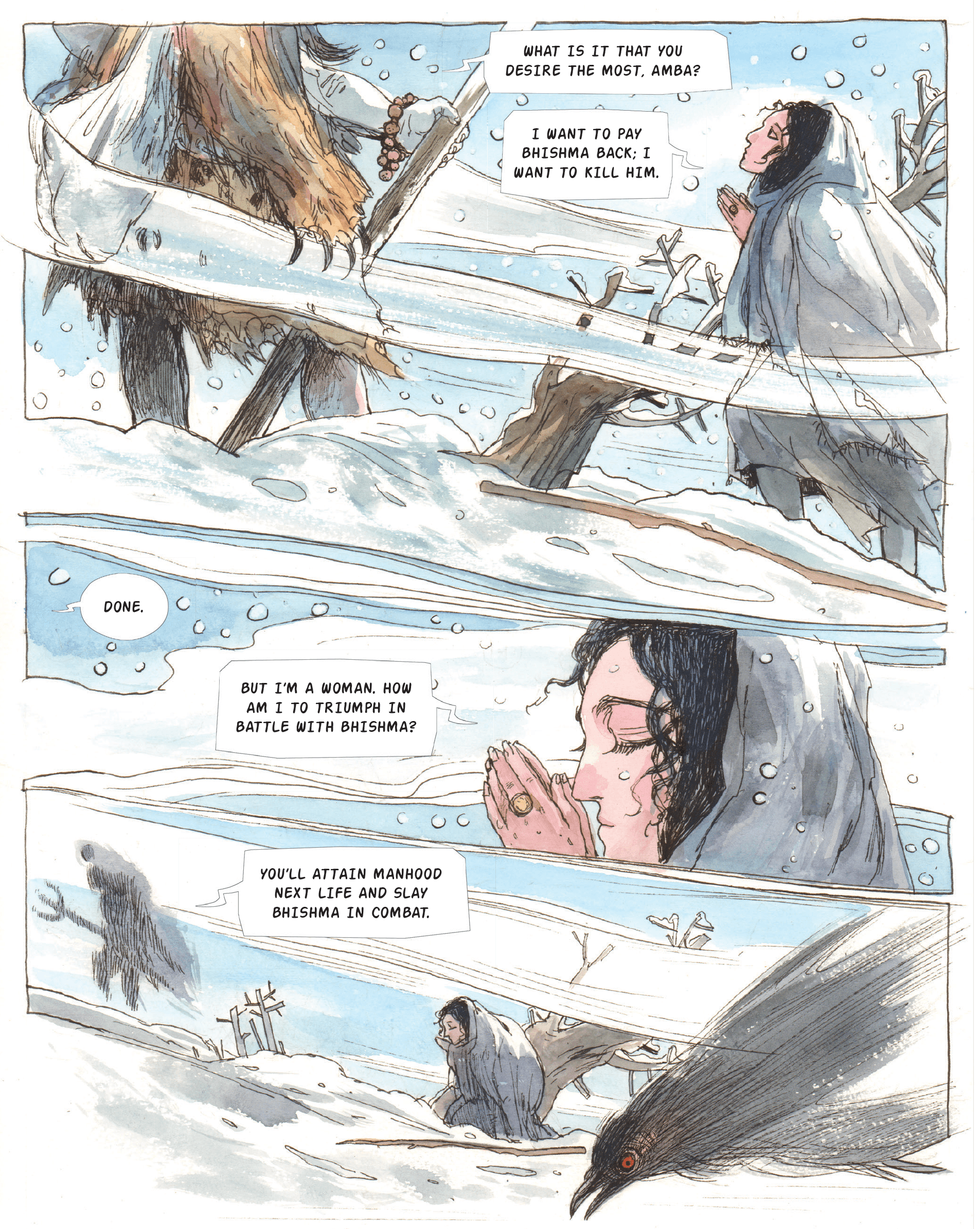

Perhaps the most innovative aspect of Banerjee's work is his understanding of sequential art as an independent language rather than an illustrated version of literature. Images do not merely repeat the written narrative; instead, they construct parallel meanings. Symbolic landscapes, fragmented panels, expressive anatomy, shifting page structures, and metaphorical imagery continually expand the philosophical dimensions of the text. Trees become emotional witnesses to violence and desire. Animals reflect human behaviour. Empty spaces between panels function as narrative pauses, while page layouts themselves communicate psychological tension during episodes such as the infamous dice game.
Banerjee's visual vocabulary is deliberately raw and tactile. Rejecting glossy fantasy aesthetics, he creates a world of rough surfaces, expressive brushwork, dramatic gestures, and emotionally charged bodies. Every wrinkle of fabric, bend of the spine, movement of the hand, and expression of the face contributes to character development. His figures possess theatrical intensity while remaining deeply human. This material quality reflects his belief that the Mahabharata is not a distant myth but a lived experience rooted in the textures of ordinary existence.
Environmental consciousness also becomes a defining element of his interpretation. Forests are not passive settings but active participants within the narrative. Trees cry during the burning of the Khandava forest, respond emotionally to violence, and appear almost sentient throughout the books. Such imagery introduces ecological readings into the epic while suggesting that non-human life possesses its own agency and memory. This ecological imagination expands the traditional boundaries of mythological illustration and positions nature as an equal participant in history.


Another defining feature of Banerjee's project is its philosophical openness. Rather than presenting fixed moral certainties, his visual storytelling encourages readers to participate actively in interpretation. Word and image frequently diverge, creating ambiguity and multiple layers of meaning. Sequential narration becomes a space where symbolism, historical research, and emotional experience intersect. This approach aligns the graphic novel with contemporary visual culture while remaining faithful to the complexity of the ancient text.
Ultimately, Sankha Banerjee's contribution extends far beyond illustrating the Mahabharata. His work represents an ambitious attempt to rethink how India's greatest epic can be seen in the twenty-first century. Through archaeological investigation, sociological observation, historical scholarship, ecological imagination, and the expressive possibilities of sequential art, he has developed a distinctive visual identity that neither imitates earlier traditions nor abandons them. Instead, his work enters into dialogue with more than two thousand years of visual culture while opening new possibilities for contemporary storytelling. In doing so, Banerjee demonstrates that the Mahabharata remains not merely an ancient text but a living visual tradition capable of continual reinvention.

SANKHA BANERJEE