

The Mahabharata stories are inexhaustible. So are the ways of retelling them. Sankha Banerjee, the artist, has teamed up with Sibaji Bandyopadhyay, the storyteller, to give us a vibrant and dramatically new graphic novel on the eventful life of the much-wronged but ever feisty Draupadi. Sankha's vivid frames move at a fast clip with Sibaji's staccato bubbles. A thrilling experience
“
”
- Partha Chatterjee, social scientist and historian
- Gulzar, poet, lyricist and film-maker
Throw the 'dice' again. Let the woman rise from the fire of our times.
Look for a new birth of Panchali in Sankha Banerjee's version of the illustrated Mahabharata
“
”
- Paul Gravett, author, Mangasia: The Definitive Guide to Pan-Asian Comic Art
Compellingly revitalised ... this classic of world literature remains timeless and timely in its questioning of power and gambling, patriarchy and prejudice, and the destruction of nature
“
”

A fascinating illustrated rendition of the all-consuming Mahabharata ...
A spectacular show of words and images dealing with love and death,
loyalty and duplicity, conflict and concord, and much more ...
Impelled by elemental forces of death, destruction and creation, Panchali, with electrifying visuals cinematically construed, reaches its climax: two consecutive games of dice. Marred by deceit, treachery and trickery, and fuelled by obsession, passion and rage, the gambling episode provides the preface to the coming, all-consuming Mahabharata war.
PANCHALI I THE GAME OF DICE
Words: Sibaji Bandyopadhyay PENGUIN INDIA, 2022
GET YOUR BOOK https://amzn.in/d/02juzRvI


Panchali: The Game of Dice (Penguin India, 2022) is not merely a retelling of one of the most celebrated episodes of the Mahabharata; it is an exploration of how images can think, question and reinterpret an ancient epic. Eminent Indian scholar Sibaji Bandyopadhyay has written the script for Panchali and Sankha as a co-author did the visual storytelling of the graphic novel. He transforms the familiar narrative of the dice game into an intense work of visual storytelling, where every page functions simultaneously as narrative, theatre, philosophy and painting. Rather than reproducing inherited iconography, Banerjee develops a distinct visual language that allows the tragedy of the dice game to unfold through symbolism, spatial composition, gesture and psychological imagery.
Unlike the first volume, Vyasa: The Beginning, which moves through multiple genealogies and narrative layers, Panchali follows a more linear dramatic structure. Beginning with the establishment of Indraprastha and gradually moving towards the fatal game of dice, the narrative accumulates political tension, jealousy and moral collapse until the royal court becomes the stage upon which the destiny of an entire civilisation is altered. The gradual progression of the story mirrors the movement of a carefully constructed tragedy, where every decision inevitably leads towards catastrophe.
The central episode of the book—the game of dice—is treated not as a simple contest of chance but as a study of addiction, probability, manipulation and the psychological disintegration of Yudhishthira. Drawing upon references from the Rigveda, the narrative explains the ancient rules of dice, the mathematical significance of the number four and even invokes principles comparable to Chaos Theory, suggesting that a seemingly insignificant throw of the dice can trigger irreversible historical consequences. Banerjee responds to these philosophical ideas visually. Mathematical diagrams, floating dice, rhythmic repetitions and slow-motion panel sequences transform abstract concepts into graphic experiences. The pages read simultaneously like an epic narrative, a philosophical treatise and an experimental visual essay.


Banerjee's most remarkable contribution lies in his refusal to let the images merely accompany the text. Throughout Panchali, the visuals create an autonomous narrative that frequently diverges from spoken dialogue. During the infamous moment when Yudhishthira wagers Draupadi, he describes her according to conventional poetic beauty—her long hair, lotus-like face and slender waist. Yet the images deliberately refuse to illustrate these descriptions. Instead, Banerjee presents Yudhishthira riding upon an enormous locust moving across the dice board, while crops emerge from the scattered dice and four phallic forms erupt from his open skull. A barren tree occupies the background like an omen of moral decay. These surreal images expose the psychological violence hidden beneath Yudhishthira's apparently composed speech. The reader is invited not simply to witness the event but to interpret its symbolic dimensions.
As the game progresses, the visual narration becomes increasingly unstable. Yudhishthira's mind is represented as a cloud-shaped brain being consumed by a crow that gradually assumes the identity of Shakuni. Elsewhere, the hero clutches the gutter space between panels as though imprisoned behind iron bars, breaking the conventional boundaries of the comic page itself. Zigzag compositions fracture the rhythm of reading, while repeated images of Shakuni multiply across the page, suggesting his omnipresent manipulation of the game. Here, the architecture of the page becomes a psychological landscape. Panels no longer function merely as containers of action; they become active participants in the narrative.
The humiliation of Draupadi constitutes the emotional and ethical centre of the book. Banerjee consciously avoids reducing this episode to spectacle. Instead, he shifts the visual emphasis from physical violence to emotional witnessing. Draupadi's eyes appear in successive close-ups that dominate the page, confronting both the assembled court and the reader. Their scale exceeds the proportions of the book itself, suggesting that the suffering of the oppressed cannot be contained within conventional representation. Parallel to these images, an anonymous labourer who had earlier appeared during the construction of Indraprastha returns in a monumental splash page. The silent gaze of this ordinary worker becomes a moral witness to the collapse of justice, transforming the episode from the humiliation of a single queen into a meditation on the vulnerability of all human beings subjected to power.


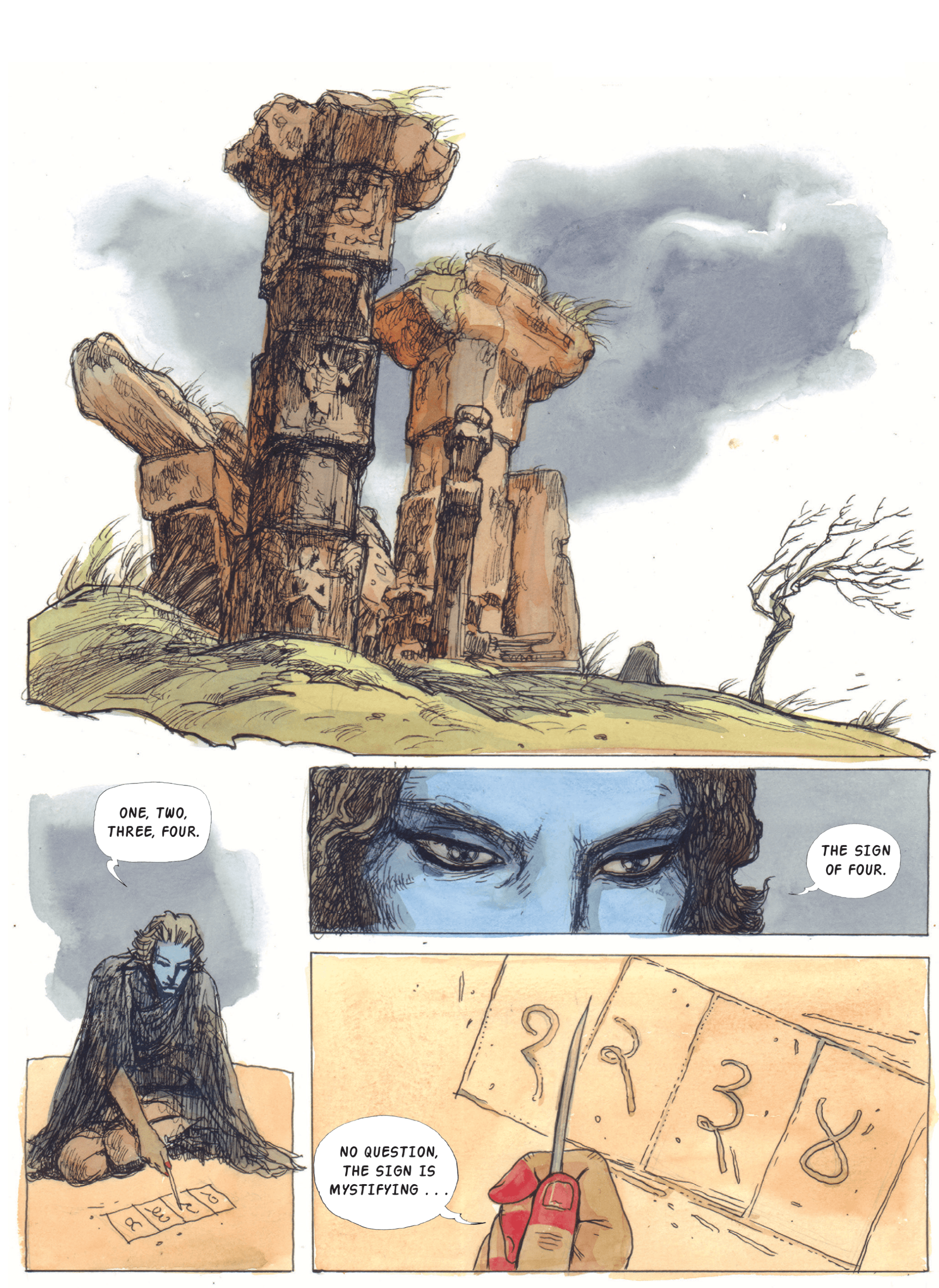

Throughout Panchali, Sankha Banerjee constructs his figures as performers rather than static illustrations. Duryodhana occupies space through expansive gestures and theatrical movement, whereas Yudhishthira remains restrained until the game gradually destroys his inner equilibrium. Clothing, bodily movement and facial expression function as extensions of character rather than decorative costume design. Thick woven garments, layered textiles and expressive folds establish social hierarchy while simultaneously conveying psychological intensity. The visual world remains deliberately tactile—rough, earthy and textured—rejecting polished mythological fantasy in favour of a material reality rooted in human experience. Forests, trees and landscapes also participate emotionally in the narrative, reinforcing Banerjee's belief that the natural world possesses its own consciousness within the epic universe.
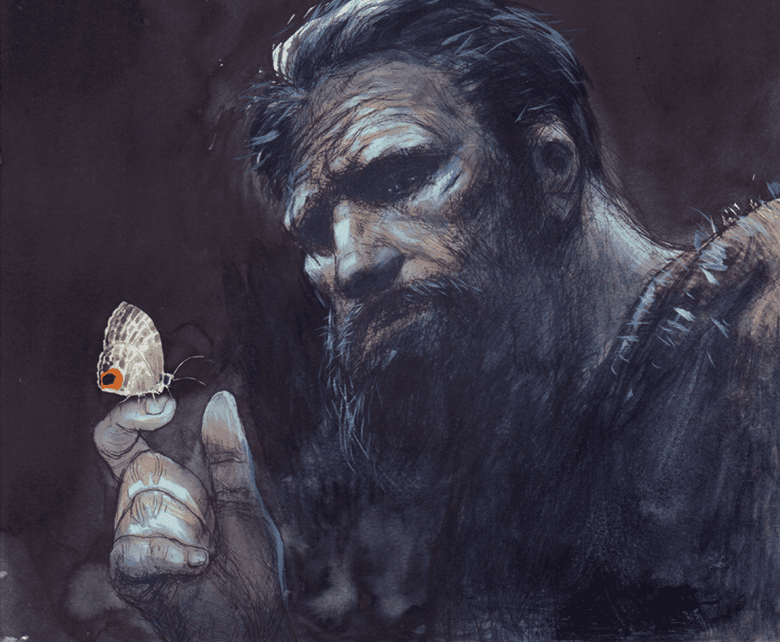

If the balance gets upset,
the tiniest addition might
bring the oderly
arrangement to the
brink of chaos.
Ultimately, Panchali: The Game of Dice demonstrates the extraordinary possibilities of sequential art as a medium for interpreting classical literature. Sankha Banerjee does not simply depict the Mahabharata; he reconstructs its emotional, philosophical and political dimensions through a sophisticated visual vocabulary where composition, symbolism, page design and metaphor carry as much narrative weight as words. The result is a contemporary graphic epic that redefines the dice game not as an isolated mythological episode but as a timeless reflection on power, desire, humiliation and the fragile architecture of human civilisation.

SANKHA BANERJEE