

TOTEM AND TABOO is a philosophical graphic narrative that revisits one of Sigmund Freud's most influential and controversial texts through the expressive possibilities of contemporary sequential art. Written and conceived by Sibaji Bandyopadhyay and visually interpreted by Sankha Banerjee, the work investigates the origins of civilization, violence and collective identity, asking how the earliest acts of prohibition continue to shape modern human consciousness.
Freud's Totem and Taboo proposed that the foundations of culture emerged through violence, guilt and ritual. According to his provocative hypothesis, the earliest social order was established through an act of collective murder that subsequently generated law, morality and religion. TOTEM AND TABOO transforms this philosophical proposition into an immersive visual narrative, exploring how every civilization constructs systems of order while simultaneously carrying the memory of its own violence. The comic suggests that beneath the appearance of stability lies an unresolved history of fear, sacrifice and repression.
The narrative extends Freud's ideas through the psychoanalytic thought of Jacques Lacan, whose understanding of language, desire and symbolic structures reveals that human identity itself is never complete. Individuals are born into systems of law and prohibition that shape both personal subjectivity and collective existence. Violence therefore becomes more than physical conflict; it is woven into the very processes through which societies define belonging, exclusion and authority.
Drawing upon the philosophical writings of Michel Foucault, the work also examines how power functions beyond overt coercion. Modern societies no longer depend solely upon visible punishment or military force. Instead, power circulates through institutions, knowledge, surveillance and social norms, producing disciplined bodies and regulated identities. By connecting Freud's speculative anthropology with Foucault's analysis of modern power, the graphic narrative demonstrates that the mechanisms of domination evolve while their underlying structures remain deeply embedded within civilization itself.
TOTEM AND TABOO
SCRIPT I SIBAJI BANDYOPADHYAY
ART I SANKHA BANERJEE
SARADIA EI SAMOY, 2017


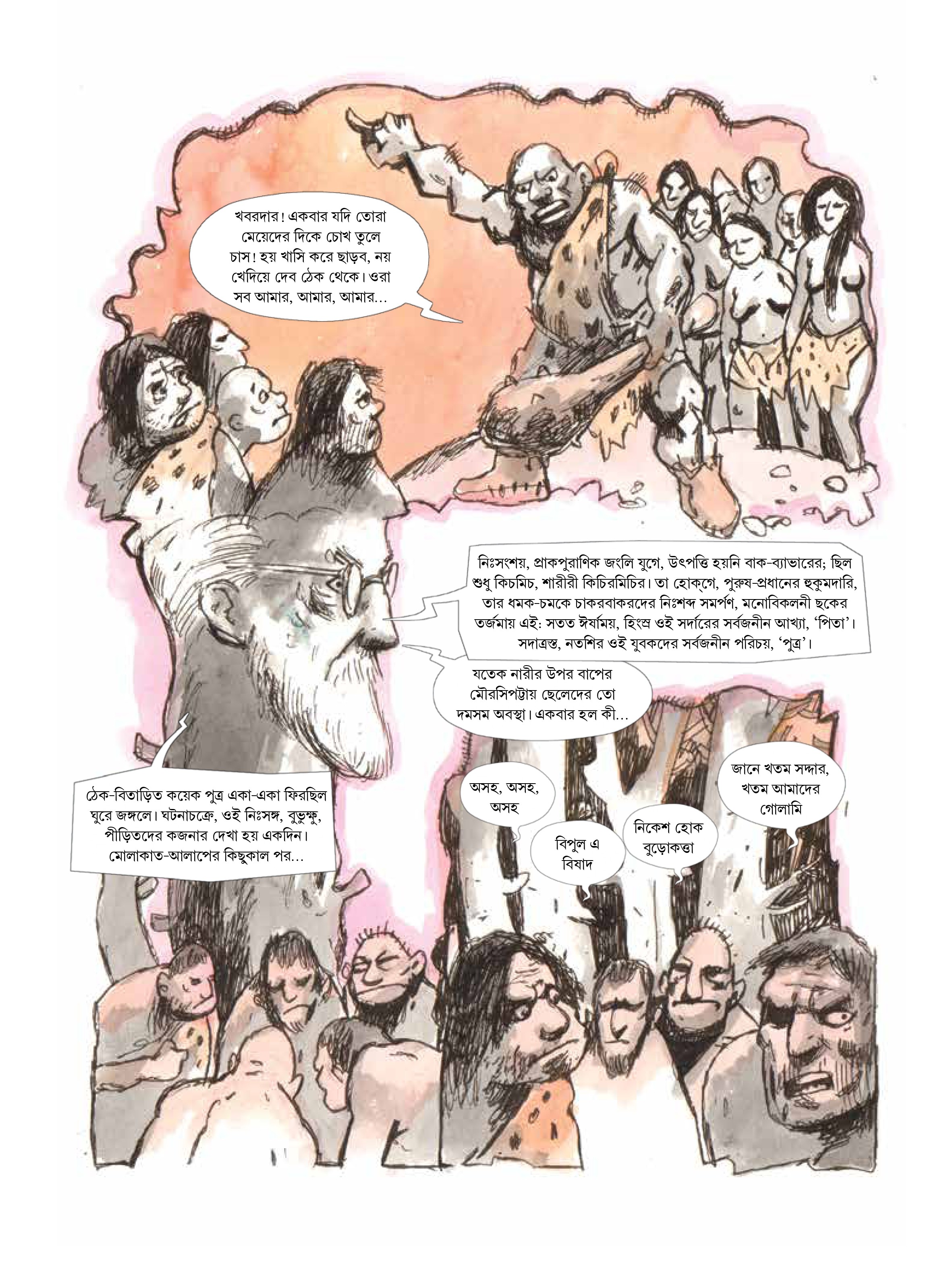
Sankha Banerjee's visual narration rejects conventional realism in favour of an expressive graphic language where symbolism, fragmented space and layered visual metaphors coexist. Human figures appear simultaneously ancient and contemporary, suggesting that the psychological structures explored by Freud continue to operate within present-day societies. Sequential imagery unfolds with cinematic rhythm, allowing philosophical arguments to emerge through atmosphere, silence and visual juxtaposition rather than through direct explanation. The result is a comic that functions equally as literature, philosophy and visual art.
Positioned within a postmodern framework, TOTEM AND TABOO questions the certainty of universal narratives and fixed truths. It proposes that history, religion, law and morality are not immutable foundations but evolving cultural constructions shaped by memory, conflict and power. The work encourages readers to reconsider the origins of the institutions they inhabit and the invisible systems that continue to govern human behaviour. Ancient myths and modern societies are revealed not as separate worlds but as interconnected expressions of the same enduring psychological structures.
Rather than offering definitive conclusions, TOTEM AND TABOO invites reflection. It demonstrates how graphic storytelling can become a powerful medium for philosophical inquiry, translating complex psychoanalytic and political thought into an emotionally resonant visual experience. Through the collaboration between Sibaji Bandyopadhyay's intellectually rigorous script and Sankha Banerjee's evocative visual narration, the work becomes a meditation on civilization itself—its origins, its contradictions and the persistent presence of violence beneath the surface of culture.


SANKHA BANERJEE
