
A Graphic Narrative
Kirat Arjun revisits one of the most profound episodes of the Mahabharata, transforming an ancient tale into a contemporary meditation on solitude, humility and self-realisation. While the narrative begins with Arjuna's quest to obtain celestial weapons from Indra before the great war of Kurukshetra, the comic gradually reveals that his greatest battle is not against an external enemy but against his own pride. The journey becomes an exploration of what it truly means to become a warrior.
Separated from his brothers, Arjuna enters the wilderness alone. The forest is not merely a geographical space but a landscape of introspection, where ambition is tested through silence, endurance and uncertainty. As he undertakes severe penance in pursuit of divine weapons, the certainty of the celebrated hero slowly begins to dissolve. The comic presents this solitary journey as an essential rite of passage, suggesting that every individual must confront isolation before discovering inner strength.
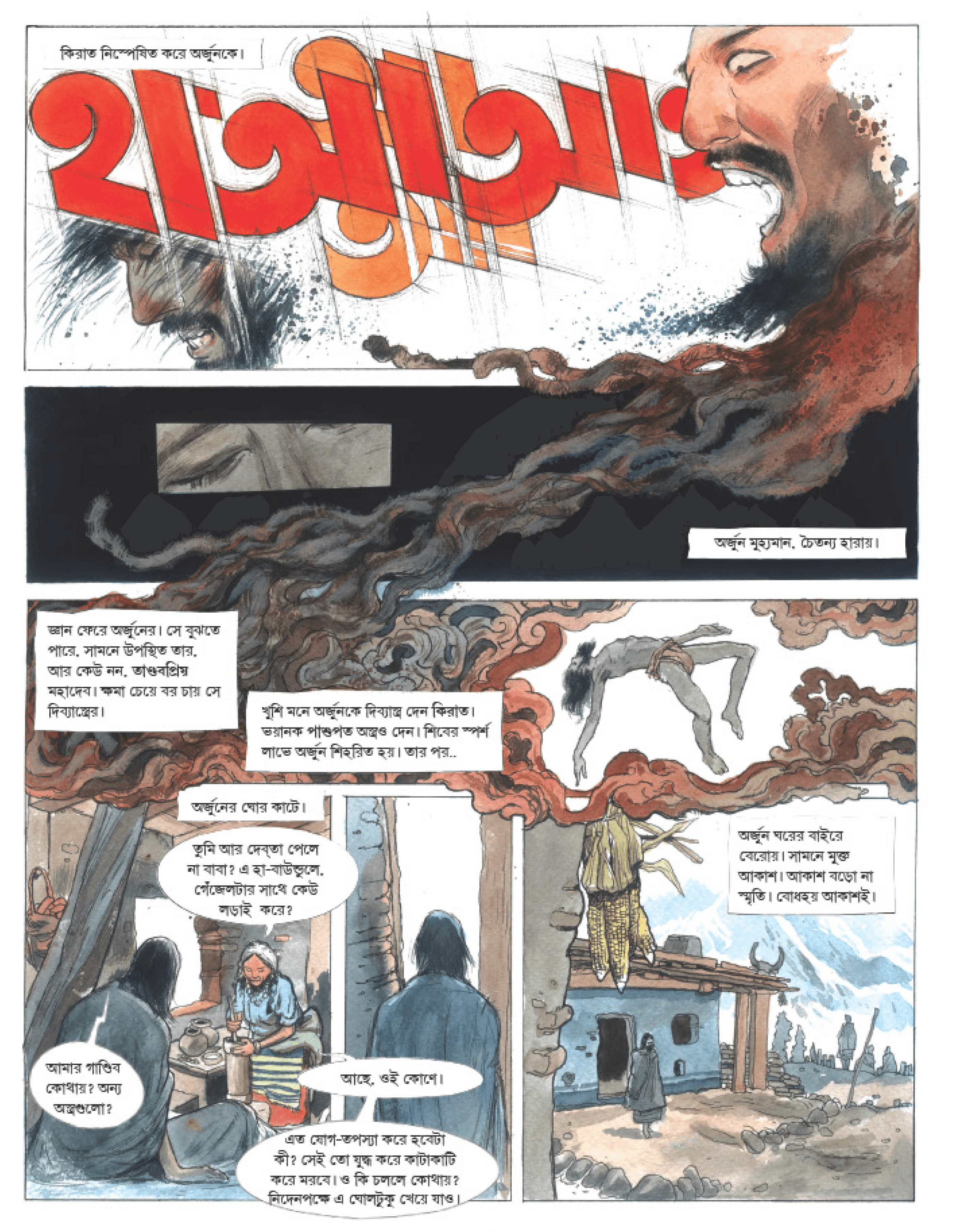
The turning point of the narrative arrives with the unexpected encounter between Arjuna and a mysterious hunter, or Kirata, who is in fact Lord Shiva in disguise. What begins as a dispute over a hunted animal soon develops into an intense duel. Confident in his extraordinary abilities, Arjuna finds himself defeated by the unknown hunter. It is only through this overwhelming defeat that he recognises the limitations of his own power and understands that true greatness demands humility as much as skill. Shiva's revelation transforms the encounter from a physical contest into a spiritual initiation, rewarding Arjuna not simply with the divine Pashupata Astra, but with a deeper understanding of himself.
Rather than presenting mythology as heroic spectacle, Sankha Banerjee interprets the episode as a deeply human narrative. The comic foregrounds the emotional and psychological dimensions of Arjuna's pilgrimage—the loneliness of walking into the unknown, the burden of expectation, the necessity of failure and the quiet resilience required to continue despite defeat. The forest becomes a metaphor for the inner world, where every challenge strips away illusion until only the individual remains before the self.


Through expressive sequential drawings and cinematic compositions, Banerjee captures both the grandeur of the epic and the intimacy of personal transformation. The rhythm of the visual narrative moves between moments of stillness and explosive action, allowing silence to become as significant as dialogue. The comic avoids treating mythology as distant history; instead, it reveals the timeless relevance of Arjuna's journey. Every reader is invited to recognise the universal experience of confronting one's own limitations before attaining wisdom.
Kirat Arjun is ultimately a story about the making of a human being rather than the making of a hero. It reminds us that the most meaningful victories are often born from defeat, and that the longest journey is not towards divine weapons or worldly success, but towards self-knowledge. In Banerjee's interpretation, Arjuna's solitary pilgrimage becomes a universal reflection on courage, humility and the quiet strength required to face both the world and oneself.


SANKHA BANERJEE
